Malcolm’s Internationalism
Go After the Puppeteer

by©️Leslye Joy Allen
Every time I think of Malcolm X and James Baldwin, I also think about their internationalism. Their realization that the battle for basic civil and human rights meant that they needed assistance and solidarity with other people of color somewhere other than the United States.
I have written about this particular vision before in different ways. My related essays below are there to read and mull over. Every time I hear (which is not often) that some Afro-American has clashed with some immigrant of color, I am reminded that these clashes are often battles for supremacy.
An Afro-American rightfully feels slighted when individuals from other countries arrive and do better financially than those of us who have been here much longer and whose African ancestors were forced to come and work for free. But I would like to point out a couple of things.
First, these cultural clashes, and particularly when they result in violence, uphold white supremacy. In order for white supremacy to flourish it is imperative that the oppressed submit to its forces by turning on others who may or may not look like them or may or may not have the same national origin. When this happens the oppression runs on automatic pilot.
Second, Malcolm X stepped away from the Colored vs. Other Colored model long enough to see how Afro-Americans and other colored peoples were both being used by the same forces who oppressed them all.
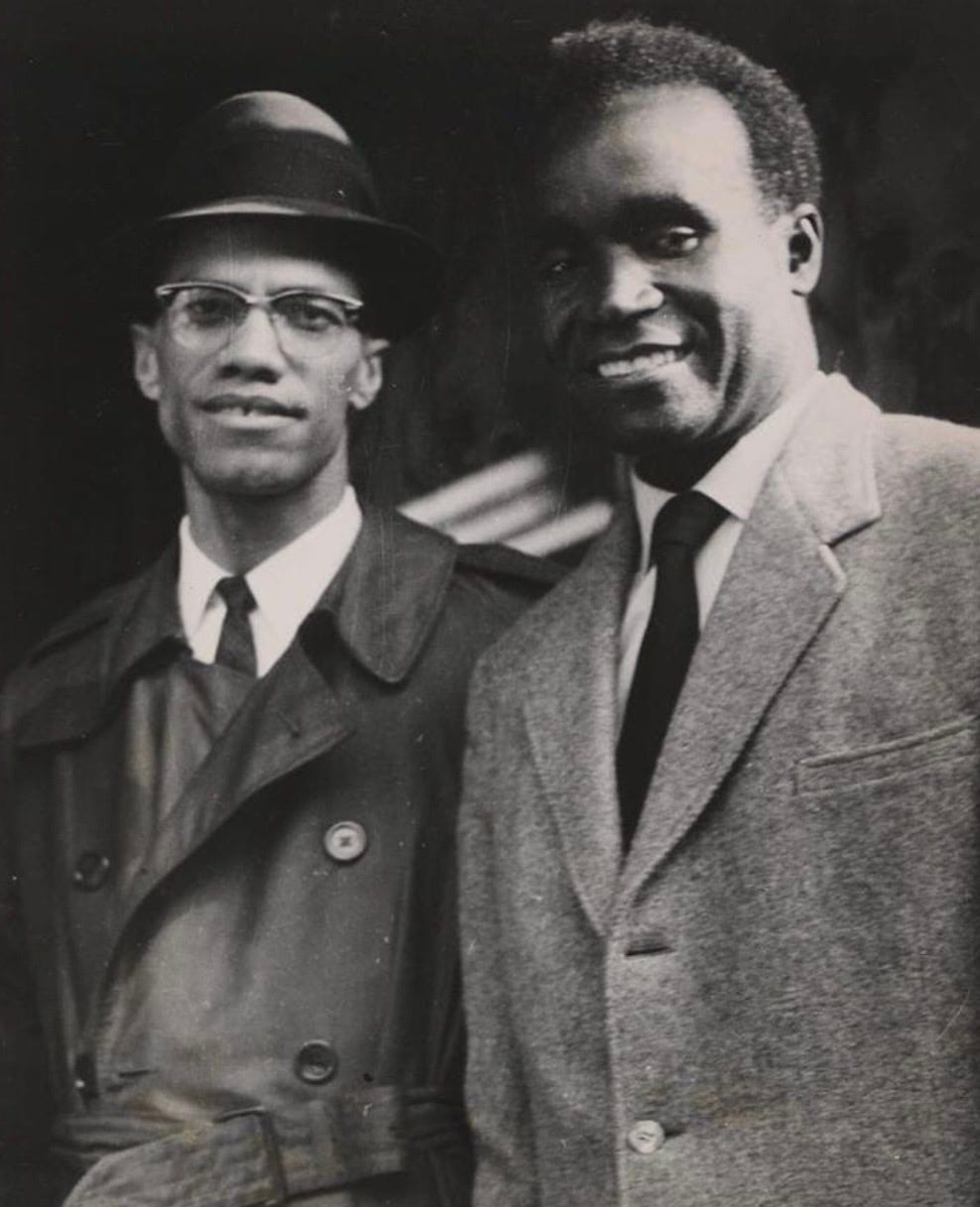
(Malcolm X and Kenneth Kaunda, the first Prime Minister of the newly independent African nation of Zambia.)
Now, this essay is not a directive not to be angry when you encounter abuse from someone who doesn’t exactly belong to your tribe. It is a suggestion, however, to check your anger long enough to figure out why the abuse is directed at you in the first place and vice-versa; and to understand fully what Malcolm X meant when he said (and I am paraphrasing him), “You Don’t Go After the Puppet. You Go After the Puppeteer.”
It is easier to resent a competitor, perceived or real, than it is to fight against those who create the atmosphere and circumstances that create the unnecessary and counterproductive competition. The puppeteer is the true enemy because he/she pulls the strings.
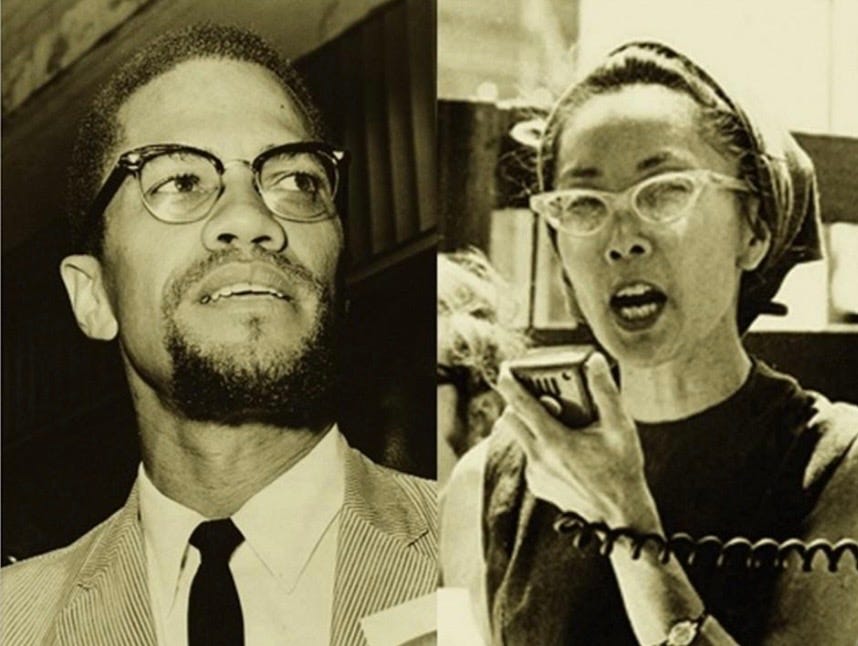
(Malcolm X and Yuri Kochiyama)
Malcolm X’s internationalism enabled him to look at how others were treated in other parts of the world and get their viewpoints. His relationships with activists and leaders like Kenneth Kaunda and Japanese activist Yuri Kochiyama who lived in Harlem and who had once been in a Japanese internment camp, kept Malcolm from being American-centric.
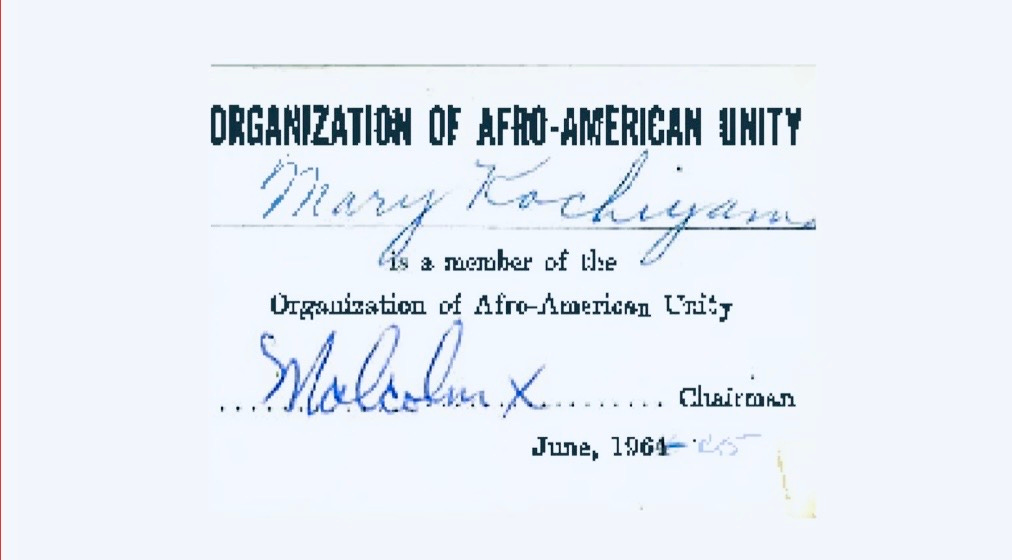
(Yuri Kochiyama’s OAAU Membership Card)
Malcolm not only challenged and cracked the codes of patriarchy and racism and sexism (see Christian Ortiz’s brilliant analysis), he also recognized the limits of parochialism. He did so not only because of his intensive studies but also because of these and many more international relationships in the United States and abroad. He did so precisely because he travelled throughout Africa and the Middle East. He did so precisely because he listened to perspectives that came from other vantage points of varying degrees of pain. The anger and fury was aimed at who it was supposed to be aimed at.
And Malcolm X did not just do this on United States soil. As journalist Les Payne and Tamara Payne wrote:
“Through his [Malcolm X] international travel, during which he saw oppression similar to that of black people in the United States, he fully understood the need to overcome the shackles of colonialism and gain control of natural resources. While speaking with students at the American University in Beirut on September 29, 1964, he advised that if they wanted to empower themselves, they needed to use their resources—especially oil—as a weapon, according to Dr. Azizah al-Hibri, one of the student organizers of this event. “Nobody had talked about that before,” Dr. al-Hibri recalled a half century later. “Nobody. He laid it out so completely and so clearly, by the end of the lecture, I think the whole place was on fire.””[1]
The American University in Beirut is in Lebanon. Right now, the United States is supporting Israel’s continued military strikes on Lebanon. While events are unfolding too fast in Iran and Lebanon to give a full analysis, it is clear that Israel and the United States are participating in the destabilization of both countries in order to cultivate the people into supporting U. S. and Israeli control over the region. Marinate on that for a while.
I am an Independent Historian, Oral Historian and Dramaturge. Please consider supporting my work and research with a few bucks for Coffee and Eggs via my CashApp or PayPal; or become a paid subscriber to me on Substack to help me sustain my research and commentary.
Notes, Recommended Books and Related Essays:
[1] Les Payne and Tamara Payne, The Dead Are Arising: The Life of Malcolm X (New York: Liveright Publishing Corporation, 2020), p. 519.
Rodnell P. Collins with A. Peter Bailey, Seventh Child: A Family Memoir of Malcolm X, (New York: Kensington Publishing Corporation, 1998).


